Example 9: Ephemeris and LansAlmanac Fitting
This tutorial shows how LuPNT compresses a numerically propagated lunar trajectory into broadcast-friendly navigation models. A receiver cannot practically receive a dense trajectory table, so a navigation service broadcasts compact parameters instead.
We compare two representations:
pnt.LansEphemeris: a short-validity, high-accuracy model consisting of an osculating two-body baseline plus Chebyshev Cartesian residual corrections;pnt.LansAlmanac: a long-validity, lower-accuracy model that fits slowly varying orbital-element histories with low-order polynomials and Fourier terms.
Both models solve the same tutorial problem: trade broadcast data size against fit error. LuPNT automates this with an agent-based pnt.Simulation: a thin EphemerisManager agent hosts an EphemerisApp that sweeps fit-window length, fits several windows, and estimates how many bits are needed per parameter to keep the worst-case position error below a target. The compute-heavy sweep is run by ex9_run_ephemeris.py; this notebook loads its results and plots them.
[1]:
import json
import os
import sys
from pathlib import Path

import numpy as np
import pandas as pd
import matplotlib.pyplot as plt

# Use THIS repo's pylupnt/data, not a stale copy on a global PYTHONPATH or kernelspec.
REPO = None
for _b in [Path.cwd(), *Path.cwd().parents]:
    if (_b / "python/pylupnt/__init__.py").exists():
        sys.path.insert(0, str((_b / "python").resolve()))
        if (_b / "data/LuPNT_data/ephemeris").is_dir():
            os.environ["LUPNT_DATA_PATH"] = str((_b / "data/LuPNT_data").resolve())
        REPO = _b
        break
import pylupnt as pnt

# The datasize/accuracy sweep is compute-heavy, so it is run *out of process* by
# `ex9_run_ephemeris.py` (which builds a `pnt.Simulation` from `configs/ephemeris.yaml`
# -- a thin `EphemerisManager` agent hosting an `EphemerisApp` -- and runs one sweep for
# the ephemeris and one for the almanac). Here we just load its outputs and plot.
DATA = REPO / "output/python_examples/ex9_data"
if not (DATA / "meta.json").exists():
    raise FileNotFoundError(
        f"{DATA} not found -- run `python ex9_run_ephemeris.py` first to generate it."
    )
meta = json.load(open(DATA / "meta.json"))
eph = dict(np.load(DATA / "results_eph.npz"))   # short-window sweep + 1-day, 60-s truth arc
alm = dict(np.load(DATA / "results_alm.npz"))   # long-window sweep + 30-day, 600-s truth arc

# Truth arcs are exported in the broadcast frame (MOON_PA), the frame the models are fit in.
eph_dt_s = float(meta["eph_sample_dt_s"])
alm_dt_s = float(meta["alm_sample_dt_s"])
t_eph_s, rv_eph_pa = eph["t_truth_s"], eph["rv_truth"]   # [N], [N x 6] MOON_PA
t_alm_s, rv_alm_pa = alm["t_truth_s"], alm["rv_truth"]
print(f"Ephemeris truth arc: {len(t_eph_s)} samples @ {eph_dt_s:.0f} s (MOON_PA)")
print(f"LansAlmanac truth arc:   {len(t_alm_s)} samples @ {alm_dt_s:.0f} s (MOON_PA)")
[00.00][PyLuPNT] Initializing
Ephemeris truth arc: 1441 samples @ 60 s (MOON_PA)
LansAlmanac truth arc:   4321 samples @ 600 s (MOON_PA)
Truth trajectory
We reuse the Elliptical Lunar Frozen Orbit (ELFO) from Example 1: classical orbital elements defined in the Moon-centered Orbital Plane (OP) frame, converted to the Moon-Centered Inertial (MCI) frame and propagated with N-body dynamics (Moon gravity
Earth/Sun third-body).
ex9_run_ephemeris.pydoes this insideEphemerisAppand exports the truth arc already rotated into the broadcast frame MOON_PA (a short, densely sampled 1-day arc for the ephemeris and a long, coarsely sampled 30-day arc for the almanac), which we loaded above.
How the models are represented
Both models are fit and evaluated in the Moon-fixed principal-axis (PA) frame. The osculating two-body elements are formed in the quasi-inertial PAI frame (the PA axes frozen at a reference epoch); PA and PAI share the same position, and their velocities differ by the Moon’s rotation \(\boldsymbol\omega = \omega_M\,\hat{\mathbf z}\) (\(\omega_M = 2.6617\times10^{-6}\,\)rad/s) about the pole:
Let \(t_k = t-t_0\) with \(t_0\) the reference epoch (the window midpoint for the ephemeris, the window start for the almanac), and \(T_{\mathrm{fit}}\) the window length.
Ephemeris (LansEphemeris)
At \(t_0\) the osculating elements \((a,e,i,\Omega,\omega,M_0)\) are read off the PA state (adding \(\boldsymbol\omega\times\mathbf r\) to recover the inertial velocity). The two-body baseline is propagated in PAI,
solved for the eccentric/true anomaly and mapped to Cartesian \(\mathbf r_{\mathrm{PAI}}(t)\), then rotated into the rotating PA frame,
with the velocity given by the exact time derivative (carrying the \(-\boldsymbol\omega\times\mathbf r\) term). A Chebyshev correction (basis \(T_0=1,\,T_1=\tau,\,T_{j+1}=2\tau T_j-T_{j-1}\) on \(\tau=2t_k/T_{\mathrm{fit}}\in[-1,1]\)) is added to each PA position component \(d\in\{x,y,z\}\), and optionally \(M\) Fourier harmonics of the argument of latitude \(u=\omega+\nu\):
The broadcast state is baseline + correction (velocity from the analytic derivatives \(\dot T_j\), \(\tfrac{d}{dt}\cos hu\), …):
The parameters \(\{a,e,i,\Omega,\omega,M_0\}\cup\{c_{d,j}\}\cup\{a_{d,h},b_{d,h}\}\) are found by linear least squares on the position residual (\(M=0\) gives the pure Chebyshev model used below).
LansAlmanac (LansAlmanac, Algorithm 2 of Iiyama & Gao)
Over a long window the almanac fits each osculating element’s time history as a low-order polynomial (\(s=t_k/T_{\mathrm{fit}}\), order \(P\); linear, \(P=1\), by default) plus a single element-specific Fourier term:
with base frequency \(\omega_a=\sqrt{\mu/a_{\mathrm{ref}}^{3}}\) (orbital mean motion) for the semi-major axis and \(\omega_\xi=4\pi/T_{\mathrm{sid}}\) (\(T_{\mathrm{sid}}=27.32\,\)d) for the rest. The mean anomaly removes the nominal two-body drift and fits only the residual with the same basis,
Crucially, instead of correcting the argument of periapsis directly, the argument of latitude is corrected,
where \(\nu\) is the true anomaly from the fitted \(M\). Building the position directly from \((a,e,i,\Omega,u)\) keeps the reconstruction well-conditioned near periapsis (the position error scales like \(r\,\delta u\), and \(r\) is smallest at periapsis), so a linear fit does not blow up on eccentric orbits. Evaluation returns the PA state (velocity via the analytic two-body rate, minus \(\boldsymbol\omega\times\mathbf r\)).
Fit-error evaluation
Fitted states are differenced against the (denser) truth and rotated into the local radial/transverse/normal (RTN) frame at each truth state, with rows \(\hat{\mathbf R}=\mathbf r/\lVert\mathbf r\rVert\), \(\hat{\mathbf N}=(\mathbf r\times\mathbf v)/\lVert\mathbf r\times\mathbf v\rVert\), \(\hat{\mathbf T}=\hat{\mathbf N}\times\hat{\mathbf R}\). For the position error \(\delta\mathbf r_k=\mathbf r^{\mathrm{fit}}_k-\mathbf r^{\mathrm{ref}}_k\) (and likewise velocity) over \(N\) samples, we report the RMS and 95th percentile of the 3-D magnitude (per-axis versions use the RTN components):
Fitting a single window
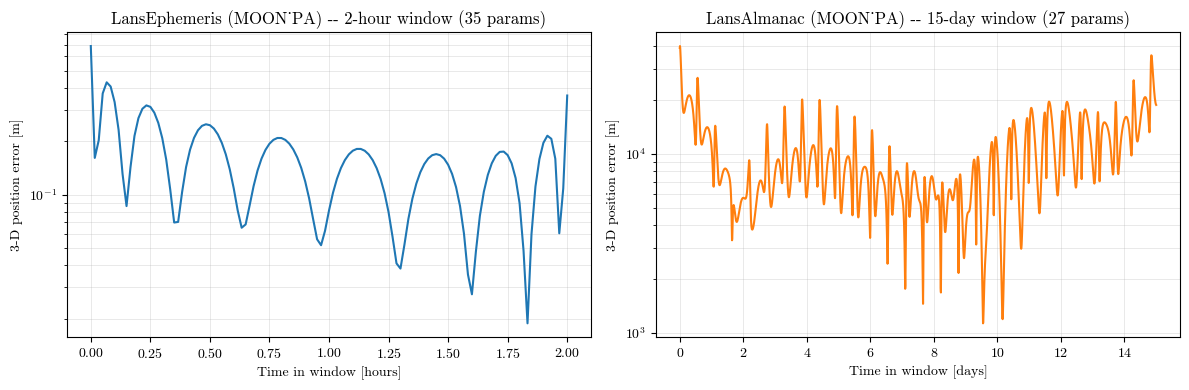
Fit each model over a window matched to its intended validity: a 2-hour window for the short-validity LansEphemeris, and a 15-day window for the long-validity LansAlmanac. Each is then evaluated against the (denser) truth samples inside its own window.
Both models are fit and evaluated in the Moon-fixed principal-axis (``MOON_PA``) frame – the rotating body-fixed frame a lunar navigation broadcast uses so that a surface user can compute topocentric geometry directly. Internally the osculating elements are fit in the quasi-inertial Principal-Axis Inertial (PAI) frame and the two-body baseline’s node drifts at the Moon’s rotation rate, placing it in the rotating output frame (EphemerisFitOptions.frame / AlmanacFitOptions.frame).
[2]:
# Ephemeris: short (2-hour) window from the densely sampled 1-day truth arc.
eph_window_hr = 2.0
n_eph = int(round(eph_window_hr * pnt.SECS_HOUR / eph_dt_s)) + 1
t_eph_win = t_eph_s[:n_eph]
rv_eph_win_pa = rv_eph_pa[:n_eph]

# LansAlmanac: long (15-day) window from the coarsely sampled 30-day truth arc.
alm_window_days = 15.0
n_alm = int(round(alm_window_days * pnt.SECS_DAY / alm_dt_s)) + 1
t_alm_win = t_alm_s[:n_alm]
rv_alm_win_pa = rv_alm_pa[:n_alm]

# The truth arcs are already in MOON_PA, so both models fit directly in the broadcast
# frame -- the frame a surface user works in (per Iiyama & Gao). Internally the osculating
# elements are fit in the Principal-Axis Inertial (PAI) frame and the two-body baseline's
# node drifts at the Moon's rotation rate, placing it in the rotating PA output frame.
cart_opts = pnt.EphemerisFitOptions()
cart_opts.poly_order = 8
cart_opts.use_keplerian_baseline = True
cart_opts.frame = pnt.MOON_PA
cart_eph = pnt.LansEphemeris(cart_opts)

# LansAlmanac (Algorithm 2 of Iiyama & Gao): each element is a *linear* polynomial plus one
# element-specific Fourier term, with the argument of periapsis replaced by an
# argument-of-latitude correction u = nu + (linear + Fourier). The u-parameterization stays
# well-conditioned near periapsis, so a linear fit is enough -- keeping the message small.
alm_opts = pnt.AlmanacFitOptions()
alm_opts.poly_order = 1
alm_opts.num_fourier_terms = 1
alm_opts.frame = pnt.MOON_PA
almanac = pnt.LansAlmanac(alm_opts)

params_cart = cart_eph.fit(t_eph_win, rv_eph_win_pa)
params_alm = almanac.fit(t_alm_win, rv_alm_win_pa)

print(
    f"LansEphemeris ({eph_window_hr:.0f}-hour window, MOON_PA): "
    f"{cart_eph.num_params()} params -> {cart_eph.param_names()}"
)
print(
    f"LansAlmanac ({alm_window_days:.0f}-day window, MOON_PA): "
    f"{almanac.num_params()} params -> {almanac.param_names()}"
)

err_cart = cart_eph.eval_error(t_eph_win, rv_eph_win_pa, params_cart)
err_alm = almanac.eval_error(t_alm_win, rv_alm_win_pa, params_alm)

summary = pd.DataFrame(
    {
        "LansEphemeris (2 hr)": [
            err_cart.rms_pos_m[3], err_cart.p95_pos_m[3],
            err_cart.rms_vel_mps[3], err_cart.p95_vel_mps[3],
        ],
        "LansAlmanac (15 day)": [
            err_alm.rms_pos_m[3], err_alm.p95_pos_m[3],
            err_alm.rms_vel_mps[3], err_alm.p95_vel_mps[3],
        ],
    },
    index=["RMS pos [m]", "95% pos [m]", "RMS vel [m/s]", "95% vel [m/s]"],
)
summary
LansEphemeris (2-hour window, MOON_PA): 35 params -> ['t_ref', 't_fit', 'a', 'e', 'i', 'raan', 'argp', 'M_ref', 'x_0', 'x_1', 'x_2', 'x_3', 'x_4', 'x_5', 'x_6', 'x_7', 'x_8', 'y_0', 'y_1', 'y_2', 'y_3', 'y_4', 'y_5', 'y_6', 'y_7', 'y_8', 'z_0', 'z_1', 'z_2', 'z_3', 'z_4', 'z_5', 'z_6', 'z_7', 'z_8']
LansAlmanac (15-day window, MOON_PA): 27 params -> ['t_ref', 't_fit', 'a_ref', 'a_p0', 'a_p1', 'a_fc1', 'a_fs1', 'e_p0', 'e_p1', 'e_fc1', 'e_fs1', 'i_p0', 'i_p1', 'i_fc1', 'i_fs1', 'raan_p0', 'raan_p1', 'raan_fc1', 'raan_fs1', 'M_p0', 'M_p1', 'M_fc1', 'M_fs1', 'u_p0', 'u_p1', 'u_fc1', 'u_fs1']
[2]:
| LansEphemeris (2 hr) | LansAlmanac (15 day) | |
|---|---|---|
| RMS pos [m] | 0.183487 | 11155.575296 |
| 95% pos [m] | 0.318143 | 19557.994585 |
| RMS vel [m/s] | 0.001540 | 1.870664 |
| 95% vel [m/s] | 0.002027 | 3.911860 |
[3]:
fit_cart = cart_eph.eval(t_eph_win, params_cart)
fit_alm = almanac.eval(t_alm_win, params_alm)

t_eph_hr = (t_eph_win - t_eph_win[0]) / pnt.SECS_HOUR
t_alm_day = (t_alm_win - t_alm_win[0]) / pnt.SECS_DAY
# Both fit and truth are in MOON_PA here.
pos_err_cart = np.linalg.norm(fit_cart[:, :3] - rv_eph_win_pa[:, :3], axis=1)
pos_err_alm = np.linalg.norm(fit_alm[:, :3] - rv_alm_win_pa[:, :3], axis=1)

fig, axes = plt.subplots(1, 2, figsize=(12, 4))

axes[0].plot(t_eph_hr, pos_err_cart, color="C0")
axes[0].set_xlabel("Time in window [hours]")
axes[0].set_ylabel("3-D position error [m]")
axes[0].set_yscale("log")
axes[0].set_title(
    f"LansEphemeris (MOON_PA) -- {eph_window_hr:.0f}-hour window "
    f"({cart_eph.num_params()} params)"
)
axes[0].grid(True, which="both", lw=0.4, alpha=0.5)

axes[1].plot(t_alm_day, pos_err_alm, color="C1")
axes[1].set_xlabel("Time in window [days]")
axes[1].set_ylabel("3-D position error [m]")
axes[1].set_yscale("log")
axes[1].set_title(
    f"LansAlmanac (MOON_PA) -- {alm_window_days:.0f}-day window "
    f"({almanac.num_params()} params)"
)
axes[1].grid(True, which="both", lw=0.4, alpha=0.5)

plt.tight_layout()
plt.show()
LansAlmanac prediction error for a South-Pole user
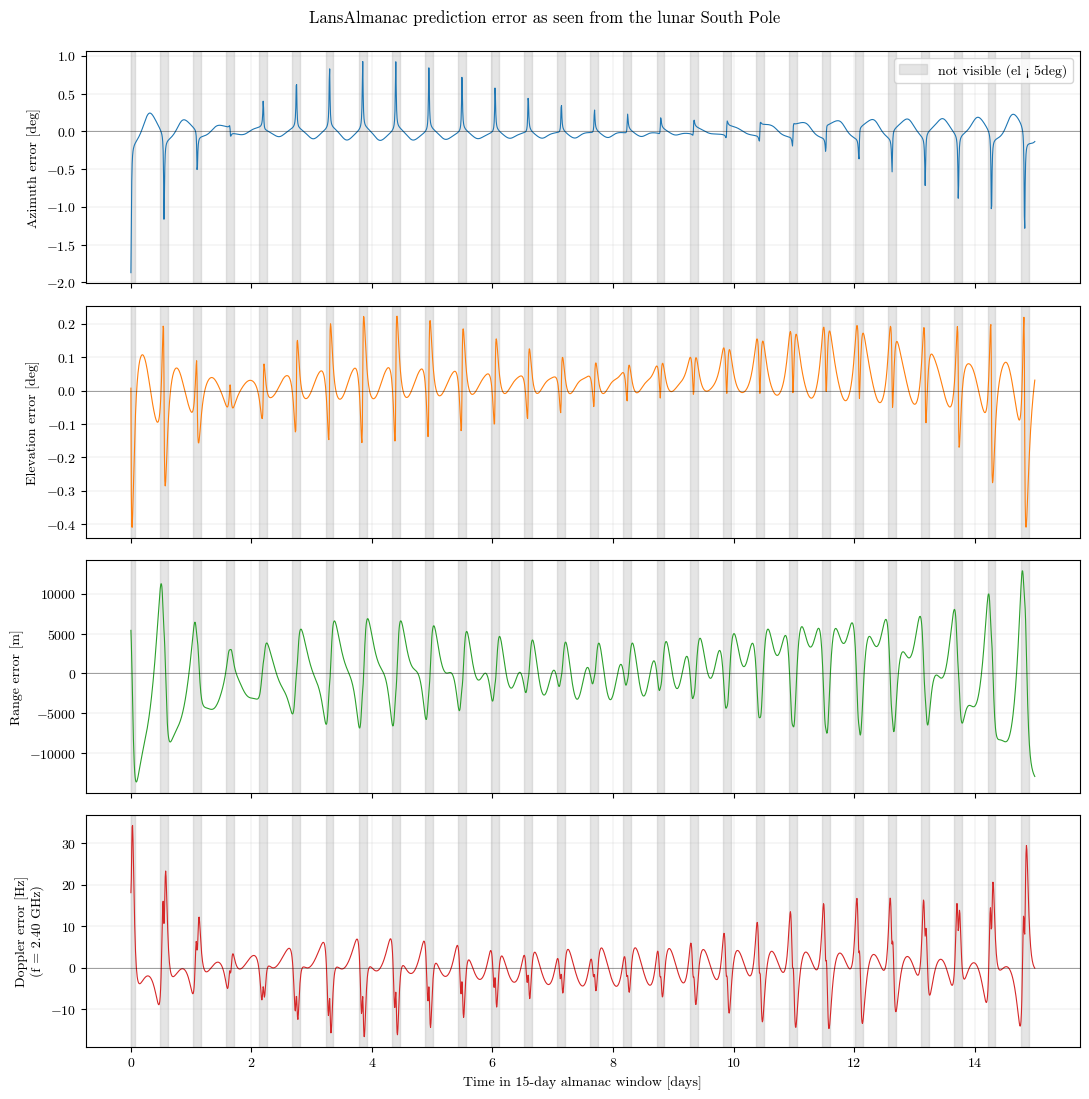
A surface user uses the almanac to assist satellite tracking: the parameters they would need are where to point it (azimuth/elevation), how far away it is (range), and how fast that range changes (the Doppler shift).
Here we push both the truth trajectory and the almanac fit (the 15-day fit from above) through those observables for a user at the lunar South Pole, and look at the almanac’s prediction error in each.
Because the almanac already broadcasts in the Moon-fixed MOON_PA frame, its prediction is directly in the user’s frame – only the truth trajectory (propagated in MCI) still needs rotating into MOON_PA. Both are then converted to azimuth/elevation/range relative to the user; range-rate is the line-of-sight relative velocity, converted to a Doppler shift at a nominal S-band carrier. We report the error statistics over the entire window and, separately, only where the satellite is
actually visible (truth elevation above 5°).
[4]:
# User at the lunar South Pole, in the Moon-fixed (MOON_PA) frame.
user_lla = np.array([-90.0, 0.0, 0.0])  # [lat deg, lon deg, alt m]
user_pa = pnt.lat_lon_alt_to_cart(user_lla, pnt.R_MOON)

f_carrier_hz = 2.4e9  # nominal S-band carrier

# Both the almanac prediction and the truth arc are already in MOON_PA (the user's frame),
# so no MCI->PA conversion is needed.
pred_pa = almanac.eval(t_alm_win, params_alm)
truth_pa = rv_alm_win_pa


def observables(rv_pa):
    """(az[deg], el[deg], range[m], range-rate[m/s], Doppler[Hz]) at the user."""
    aer = np.asarray(pnt.cart_to_az_el_range(rv_pa[:, :3], user_pa))
    az_deg = np.rad2deg(aer[:, 0])
    el_deg = np.rad2deg(aer[:, 1])
    rng_m = aer[:, 2]
    rel = rv_pa[:, :3] - user_pa
    range_rate = np.sum(rel * rv_pa[:, 3:], axis=1) / np.linalg.norm(rel, axis=1)
    doppler_hz = -range_rate * f_carrier_hz / pnt.C
    return az_deg, el_deg, rng_m, range_rate, doppler_hz


az_t, el_t, rng_t, rr_t, dop_t = observables(truth_pa)
az_p, el_p, rng_p, rr_p, dop_p = observables(pred_pa)


def wrap_deg(d):  # wrap an angular error into [-180, 180) deg
    return (d + 180.0) % 360.0 - 180.0


az_err = wrap_deg(az_p - az_t)  # [deg]
el_err = el_p - el_t  # [deg]
rng_err = rng_p - rng_t  # [m]
dop_err = dop_p - dop_t  # [Hz]

visible = el_t > 5.0  # truth elevation above the 5 deg mask
t_alm_day = (t_alm_win - t_alm_win[0]) / pnt.SECS_DAY
[5]:
panels = [
    (az_err, "Azimuth error [deg]", "C0"),
    (el_err, "Elevation error [deg]", "C1"),
    (rng_err, "Range error [m]", "C2"),
    (dop_err, f"Doppler error [Hz]\n(f = {f_carrier_hz / 1e9:.2f} GHz)", "C3"),
]

fig, axes = plt.subplots(4, 1, figsize=(11, 11), sharex=True)
for ax, (y, ylabel, color) in zip(axes, panels):
    ax.plot(t_alm_day, y, lw=0.8, color=color)
    ax.axhline(0.0, color="k", lw=0.5, alpha=0.5)
    lo, hi = ax.get_ylim()
    ax.fill_between(
        t_alm_day,
        lo,
        hi,
        where=~visible,
        color="0.6",
        alpha=0.25,
        label="not visible (el < 5deg)",
    )
    ax.set_ylim(lo, hi)
    ax.set_ylabel(ylabel)
    ax.grid(True, lw=0.3, alpha=0.5)

axes[0].legend(loc="upper right")
axes[-1].set_xlabel("Time in 15-day almanac window [days]")
fig.suptitle("LansAlmanac prediction error as seen from the lunar South Pole", y=0.995)
plt.tight_layout()
plt.show()
[6]:
# Statistics over the entire window vs. only where the satellite is visible.
def err_stats(err, mask):
    x = err[mask]
    ax = np.abs(x)
    return np.sqrt(np.mean(x**2)), np.mean(x), np.percentile(ax, 95), ax.max()


all_mask = np.ones_like(visible, dtype=bool)
metrics = {
    "Azimuth [deg]": az_err,
    "Elevation [deg]": el_err,
    "Range [m]": rng_err,
    "Doppler [Hz]": dop_err,
}

records = []
for name, err in metrics.items():
    for scope, mask in [
        ("entire trajectory", all_mask),
        ("visible (el>5deg)", visible),
    ]:
        rms, bias, p95, mx = err_stats(err, mask)
        records.append((name, scope, rms, bias, p95, mx))

stats_tbl = pd.DataFrame.from_records(
    records, columns=["error", "scope", "RMS", "bias", "P95|err|", "max|err|"]
).set_index(["error", "scope"])

print(
    f"Samples: {len(el_t)} total, {int(visible.sum())} visible "
    f"({100 * visible.mean():.1f}% of the 15-day window); "
    f"truth elevation in [{el_t.min():.1f}, {el_t.max():.1f}] deg"
)
stats_tbl
Samples: 2161 total, 1625 visible (75.2% of the 15-day window); truth elevation in [-73.7, 58.3] deg
[6]:
| RMS | bias | P95|err| | max|err| | ||
|---|---|---|---|---|---|
| error | scope | ||||
| Azimuth [deg] | entire trajectory | 0.142403 | -0.000310 | 0.215596 | 1.870438 |
| visible (el>5deg) | 0.081998 | 0.001794 | 0.159643 | 0.242229 | |
| Elevation [deg] | entire trajectory | 0.075164 | 0.023250 | 0.160628 | 0.409181 |
| visible (el>5deg) | 0.048555 | 0.021228 | 0.100058 | 0.218027 | |
| Range [m] | entire trajectory | 4152.540859 | 40.532033 | 8149.194963 | 13639.915443 |
| visible (el>5deg) | 4035.558768 | 184.203497 | 8096.330867 | 13639.915443 | |
| Doppler [Hz] | entire trajectory | 5.377840 | 0.117983 | 12.288938 | 34.307913 |
| visible (el>5deg) | 3.123220 | 0.037288 | 6.249022 | 14.144406 |
Accuracy vs. datasize trade-off
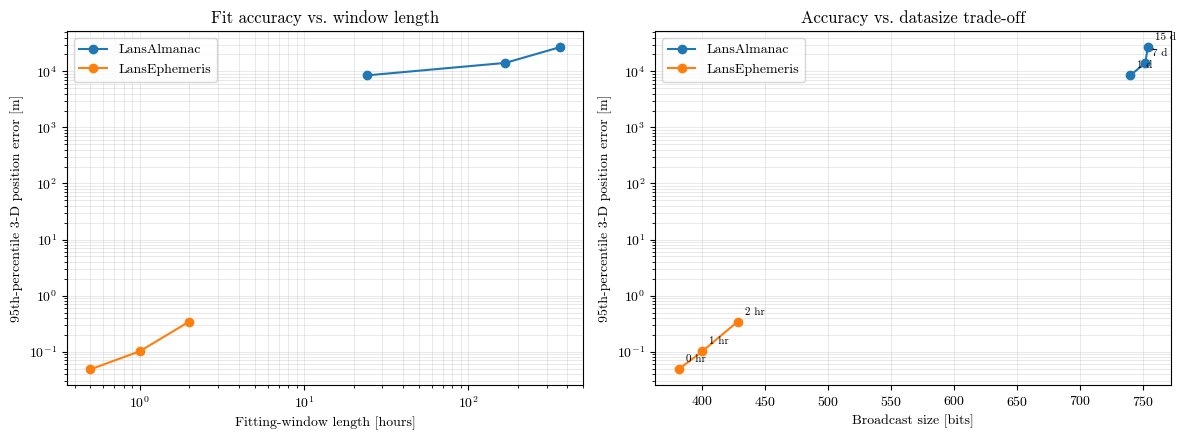
The agent-based EphemerisApp automates the study above across a sweep of fitting-window lengths: for each window length it samples several windows across the truth trajectory, fits/evaluates both models on each, and searches (by bisection) the minimum per-parameter broadcast resolution that keeps the worst-case position error (over the window) under datasize_precision_m – giving a total bit count per window length. ex9_run_ephemeris.py runs it twice (once per model’s validity range)
via pnt.Simulation, and we load those results below.
The reported accuracy is the realized broadcast error. For each parameter \(\theta_j\) a bisection finds the fewest fractional bits \(k_j\) such that perturbing \(\theta_j\) by \(2^{-k_j}\) moves the position – anywhere in the window – by less than the target \(\varepsilon\); the broadcast value is quantized to that resolution,
and the orbit is re-evaluated from \(\hat{\boldsymbol\theta}\) – i.e. what a receiver decoding the message actually gets, consistent with the total_bits datasize (a well-below-precision raw fit is therefore floored to \(\sim\varepsilon\)). Bounding the worst-case offset (not the mean) matters for the eccentric almanac, where a coarse parameter step would otherwise spike the position near periapsis.
A single sweep fits both models on the same windows, so to sweep each model over its own validity range we run two simulations:
an ephemeris sweep over short windows (up to 2 hours) on a 1-day truth trajectory, and
an almanac sweep over long windows (up to 15 days) on a 30-day truth trajectory (coarser sampling, since the almanac is a coarse model),
keeping only the LansEphemeris results from the first and the LansAlmanac results from the second.
[7]:
def results_to_df(d, prefix, label):
    df = pd.DataFrame(
        {
            "fit_window_min": d[f"{prefix}_fit_window_min"],
            "num_params": d[f"{prefix}_num_params"].astype(int),
            "total_bits": d[f"{prefix}_total_bits"].astype(int),
            "pos_rms_m": d[f"{prefix}_pos_rms_m"],
            "pos_p95_m": d[f"{prefix}_pos_p95_m"],
            "vel_rms_mmps": d[f"{prefix}_vel_rms_mps"] * 1000,
            "vel_p95_mmps": d[f"{prefix}_vel_p95_mps"] * 1000,
        }
    )
    df["model"] = label
    return df


# Keep the LansEphemeris results from the short (ephemeris) sweep and the LansAlmanac
# results from the long (almanac) sweep -- each model over its own validity range.
df_cart = results_to_df(eph, "cart", "LansEphemeris")
df_alm = results_to_df(alm, "alm", "LansAlmanac")
df = pd.concat([df_cart, df_alm], ignore_index=True)
df
[7]:
| fit_window_min | num_params | total_bits | pos_rms_m | pos_p95_m | vel_rms_mmps | vel_p95_mmps | model | |
|---|---|---|---|---|---|---|---|---|
| 0 | 30.0 | 29 | 381 | 0.029703 | 0.048455 | 0.151181 | 0.296338 | LansEphemeris |
| 1 | 60.0 | 29 | 400 | 0.057305 | 0.102119 | 0.448422 | 0.896479 | LansEphemeris |
| 2 | 120.0 | 29 | 428 | 0.196987 | 0.344541 | 1.060722 | 1.795795 | LansEphemeris |
| 3 | 1440.0 | 27 | 740 | 5519.491364 | 8452.327157 | 780.937350 | 1736.588293 | LansAlmanac |
| 4 | 10080.0 | 27 | 752 | 8394.235543 | 14140.676968 | 1424.180137 | 3336.775527 | LansAlmanac |
| 5 | 21600.0 | 27 | 754 | 16097.016549 | 26889.361313 | 2403.780638 | 5474.014415 | LansAlmanac |
[8]:
fig, axes = plt.subplots(1, 2, figsize=(12, 4.5))

for label, sub in df.groupby("model"):
    sub = sub.sort_values("fit_window_min")
    win_hr = sub["fit_window_min"] / 60.0  # window length in hours
    axes[0].plot(win_hr, sub["pos_p95_m"], "o-", label=label)
    axes[1].plot(sub["total_bits"], sub["pos_p95_m"], "o-", label=label)
    for _, row in sub.iterrows():
        w_hr = row.fit_window_min / 60.0
        tag = f"{w_hr:.0f} hr" if w_hr < 24 else f"{w_hr / 24:.0f} d"
        axes[1].annotate(
            tag,
            (row.total_bits, row.pos_p95_m),
            textcoords="offset points",
            xytext=(5, 5),
            fontsize=8,
        )

axes[0].set_xlabel("Fitting-window length [hours]")
axes[0].set_xscale("log")
axes[0].set_ylabel("95th-percentile 3-D position error [m]")
axes[0].set_yscale("log")
axes[0].set_title("Fit accuracy vs. window length")
axes[0].legend()
axes[0].grid(True, which="both", lw=0.4, alpha=0.5)

axes[1].set_xlabel("Broadcast size [bits]")
axes[1].set_ylabel("95th-percentile 3-D position error [m]")
axes[1].set_yscale("log")
axes[1].set_title("Accuracy vs. datasize trade-off")
axes[1].legend()
axes[1].grid(True, which="both", lw=0.4, alpha=0.5)

plt.tight_layout()
plt.show()
Ephemeris bit allocation per parameter
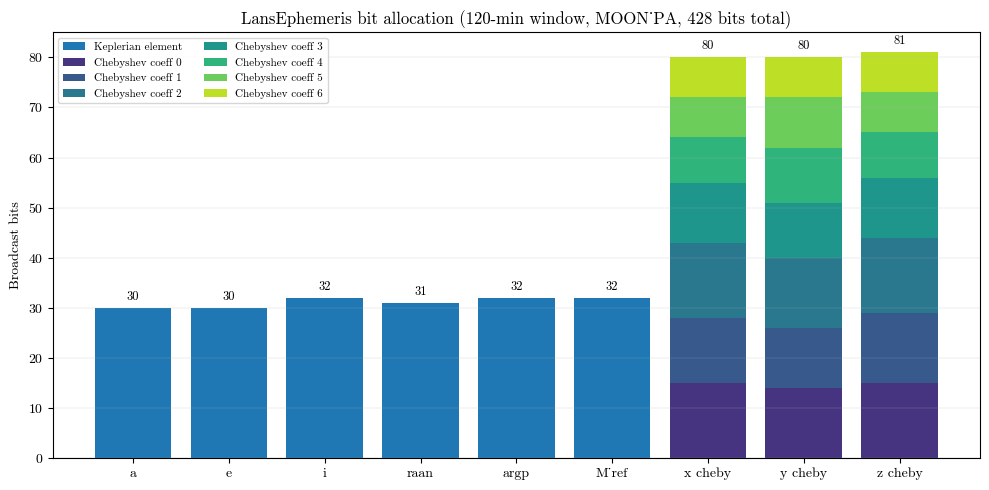
The trade-off above summarizes each fit by a single total_bits. Here we open up that number for the LansEphemeris and show how the broadcast bits are distributed across its parameters: the six Keplerian baseline elements (a, e, i, RAAN, argument of perigee, reference mean anomaly) and the three per-axis Chebyshev position-correction blocks (x, y, z), stacked by coefficient order. For each parameter a bisection search finds the coarsest quantization (fewest fractional bits) that still
keeps the worst-case position error under the target precision, and the integer part is sized from the parameter’s range – exactly the budget behind the ephemeris point in the trade-off, so the bars sum to that same total.
[9]:
# Per-parameter bit allocation behind the ephemeris "total_bits" in the trade-off above.
# Mirrors SummarizeWindows / SearchParamBits / RangeBits in
# cpp/lupnt/applications/ephemeris/ephemeris_app.cc: for each parameter a bisection finds
# the fewest fractional bits whose quantization keeps the worst-case (max-over-window)
# position error under datasize_precision_m, and the integer part is sized from the
# parameter's range. Same settings as the ephemeris sweep (poly_order 6, MOON_PA output),
# so the bars sum to that sweep's ephemeris total_bits.
bit_window_min = 120.0
bit_precision_m = float(meta["datasize_precision_m"])
bit_num_windows = int(meta["num_windows"])

opt_bits = pnt.EphemerisFitOptions()
opt_bits.poly_order = int(meta["cartesian_poly_order"])
opt_bits.use_keplerian_baseline = True
opt_bits.frame = pnt.MOON_PA
eph_bits = pnt.LansEphemeris(opt_bits)
bit_names = eph_bits.param_names()
n_bit_params = eph_bits.num_params()

# The 1-day ephemeris truth arc is already in MOON_PA.
rv_truth_eph_pa = rv_eph_pa


def _search_param_bits(eph_model, t_s, params, idx, precision_m, max_bits=50):
    base = eph_model.eval(t_s, params)[:, :3]

    def perturbed_err(k):
        eps = 2.0 ** (-k)
        q = params.copy()
        q[idx] += eps
        plus = eph_model.eval(t_s, q)[:, :3]
        q[idx] -= 2.0 * eps
        minus = eph_model.eval(t_s, q)[:, :3]
        return max(
            np.max(np.linalg.norm(plus - base, axis=1)),
            np.max(np.linalg.norm(minus - base, axis=1)),
        )

    lo, hi = 0, max_bits
    if perturbed_err(lo) <= precision_m:
        return lo
    if perturbed_err(hi) > precision_m:
        return hi
    while hi - lo > 1:
        mid = (lo + hi) // 2
        if perturbed_err(mid) <= precision_m:
            hi = mid
        else:
            lo = mid
    return hi


def _range_bits(rng, bits_frac, signed, margin):
    bits_range = max(1, int(np.ceil(np.log2(rng)))) if rng > 0 else 1
    return bits_range + max(bits_frac, 0) + (1 if signed else 0) + (1 if margin else 0)


def _classify(name):
    # (range, signed, margin_bit); range=None means "use the parameter's max |value|"
    if name[0] == "i" or name.startswith("raan") or name.startswith("argp") or name[0] == "M":
        return 2.0 * np.pi, True, False  # angular element
    if name[0] == "e":
        return 1.0, False, False  # eccentricity in [0, 1)
    if name[0] == "a":
        return None, False, True  # semi-major axis
    return None, True, True  # Chebyshev coefficient


# Sample the same windows the sweep uses across the 1-day ephemeris truth arc.
n_arc = len(t_eph_s)
win_pts = int(round(bit_window_min * pnt.SECS_MINUTE / eph_dt_s)) + 1
margin = win_pts // 2
span = max(1, n_arc - 1 - 2 * margin)
starts = []
for wnd in range(bit_num_windows):
    frac = wnd / (bit_num_windows - 1) if bit_num_windows > 1 else 0.5
    s = margin + int(round(frac * span)) - win_pts // 2
    starts.append(max(0, min(s, n_arc - win_pts)))

max_k = np.zeros(n_bit_params)
max_abs = np.zeros(n_bit_params)
for s in starts:
    t_win = t_eph_s[s : s + win_pts]
    rv_win = rv_truth_eph_pa[s : s + win_pts]
    p_fit = eph_bits.fit(t_win, rv_win)
    for j in range(2, n_bit_params):  # params 0,1 (t_ref, t_fit) are not broadcast-quantized
        max_abs[j] = max(max_abs[j], abs(p_fit[j]))
        max_k[j] = max(max_k[j], _search_param_bits(eph_bits, t_win, p_fit, j, bit_precision_m))

param_bits = np.zeros(n_bit_params, dtype=int)
for j in range(2, n_bit_params):
    rng, signed, margin_bit = _classify(bit_names[j])
    if rng is None:
        rng = max_abs[j]
    param_bits[j] = _range_bits(rng, int(max_k[j]), signed, margin_bit)

total_bits = int(param_bits.sum())
print(
    f"LansEphemeris {bit_window_min:.0f}-min window (MOON_PA), poly_order "
    f"{opt_bits.poly_order}: {total_bits} total bits (matches the ephemeris trade-off point)"
)

# Bar plot: Keplerian elements (single bars) + x/y/z Chebyshev blocks (stacked by order).
kep = ["a", "e", "i", "raan", "argp", "M_ref"]
kep_bits = [param_bits[bit_names.index(nm)] for nm in kep]
poly = opt_bits.poly_order
labels = kep + ["x cheby", "y cheby", "z cheby"]
xpos = np.arange(len(labels))

fig, ax = plt.subplots(figsize=(10, 5))
ax.bar(xpos[:6], kep_bits, color="C0", label="Keplerian element")

coeff_colors = plt.cm.viridis(np.linspace(0.15, 0.9, poly + 1))
for axi, axis_name in enumerate("xyz"):
    bottom = 0
    for k in range(poly + 1):
        b = param_bits[bit_names.index(f"{axis_name}_{k}")]
        ax.bar(
            6 + axi, b, bottom=bottom, color=coeff_colors[k],
            label=f"Chebyshev coeff {k}" if axi == 0 else None,
        )
        bottom += b

for idx_, lbl in enumerate(labels):
    tot = (
        kep_bits[idx_]
        if idx_ < 6
        else sum(param_bits[bit_names.index(f"{lbl[0]}_{k}")] for k in range(poly + 1))
    )
    ax.text(idx_, tot + 1, str(int(tot)), ha="center", va="bottom", fontsize=9)

ax.set_xticks(xpos)
ax.set_xticklabels(labels)
ax.set_ylabel("Broadcast bits")
ax.set_title(
    f"LansEphemeris bit allocation "
    f"({bit_window_min:.0f}-min window, MOON_PA, {total_bits} bits total)"
)
ax.grid(True, axis="y", lw=0.3, alpha=0.5)
ax.legend(ncol=2, fontsize=8, loc="upper left")
plt.tight_layout()
plt.show()
LansEphemeris 120-min window (MOON_PA), poly_order 6: 428 total bits (matches the ephemeris trade-off point)
Takeaways
A precise ephemeris and a coarse almanac are different points on the same compression problem: fewer bits and longer validity usually mean larger prediction error.
LansEphemerisremoves most of the orbital motion analytically with a two-body baseline, so the Chebyshev polynomial only fits the smooth perturbation residual.LansAlmanacis intentionally lower fidelity but remains useful for acquisition, pointing, and coarse geometry over many days.Expressing fit error in RTN coordinates reveals whether the model is dominated by radial, along-track, or cross-track compression error.
The same LuPNT classes used here can be embedded in constellation simulations to study broadcast-message design.